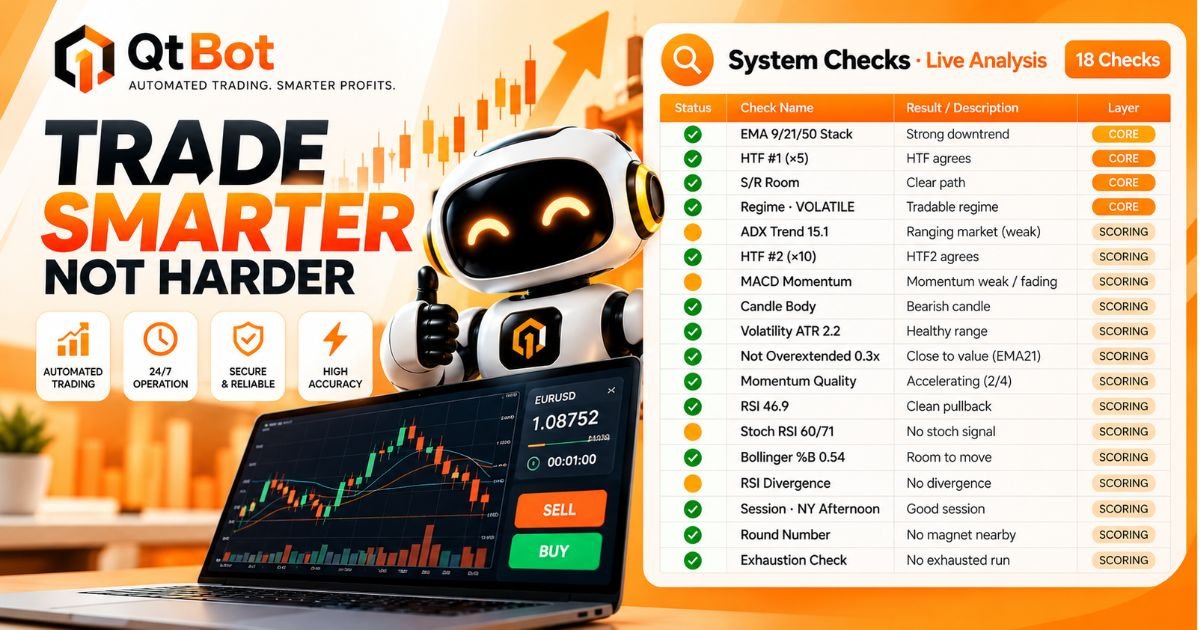
How Qoutex Trading Bot Works: A Look Inside the 18-Check Real-Time Analysis Engine
Qoutex Trading Bot isn't a "magic indicator." It's a structured, rule-based system that walks through 18 different market conditions before it ever shows you a signal.
If you've spent any time in trading circles, you've probably seen bots that promise the world with a single moving average crossover. You hit "buy" because the line crossed another line, and then you watch in confusion as price reverses directly into a support zone you didn't notice.
That is precisely the problem Qoutex was built to address.
Instead of relying on one indicator to shout "BUY" or "SELL," this system runs a live, multi-layered interrogation of the chart. It checks trend structure, higher timeframes, support and resistance, momentum, volatility, and even exhaustion. The goal isn't to predict the future with certainty—it's to give you a transparent, real-time snapshot of what the market looks like right now according to a consistent set of rules.
You can explore the bot and see the live analysis interface here: [Insert Official Qoutex Trading Bot Link Here]
Why an 18-Check System Beats a Single Indicator
Imagine an EMA crossover tells you the trend is bearish. Should you sell immediately?
Not necessarily. Price might be sitting right on top of a major support level. The higher timeframe might still be screaming bullish. Momentum might already be fading, or the move might be so overextended that you'd be chasing the bottom.
The 18-check engine doesn't ask, "Is this one indicator green or red?" It asks a much more useful question:
"How much independent evidence actually supports this setup, and is anything structurally broken?"
This is the difference between a toy signal and a serious analytical tool.
The Two Layers: CORE and SCORING
The 18 checks aren't all treated equally. They're split into two distinct categories, which is a crucial design choice.
The CORE Layer (The Non-Negotiables)
These are the structural filters. If these fail, the setup usually isn't worth considering, no matter how many minor indicators agree.
EMA 9/21/50 Stack:
It looks at the structure of the moving averages, not just a crossover. Is the 9 above the 21, and the 21 above the 50? That tells you about the underlying short-to-medium-term trend health.
Higher-Timeframe (HTF) Confirmation:
A setup that looks gorgeous on the 1-minute chart might be a terrible idea on the 1-hour. The bot checks the broader context to make sure you aren't fighting the dominant trend.
Support & Resistance Room:
A valid direction is useless if price is about to hit a brick wall of resistance. This check asks: "Is there actually space for the trade to move?"
Market Regime:
Markets trend, range, and compress. The bot checks whether the current environment is actually suitable for the type of setup being analyzed.
The SCORING Layer (The Weight of Evidence)
Once the CORE structure is validated, the bot runs the remaining 14 checks. These don't act as hard vetoes; instead, they provide supporting, neutral, or conflicting evidence.
- ADX: Is there actual trend strength, or is the market just chopping sideways?
- HTF #2: A second higher-timeframe perspective for extra confluence.
- MACD & Momentum Quality: Is momentum accelerating, stable, or deteriorating?
- Candle Body Analysis: What is the immediate price action saying?
- ATR & Overextension: Is volatility healthy, or has price traveled too far, too fast?
- RSI & Stochastic RSI: Interpreting momentum and pullbacks in context, not just blindly reading a 70/30 level.
- Bollinger %B: Where is price relative to the bands, and does it have room to run?
- RSI Divergence: Is price making a new high while momentum makes a lower high? (A classic warning sign).
- Trading Session: Are we in a session where this asset actually moves?
- Round Number Check: Is there a psychological magnet (like a whole number) sitting nearby that might stall price?
- Exhaustion Check: Is this move already mature? Are you about to chase a move that's already done 90% of its work?
What a Real Analysis Actually Looks Like
Here's the thing about real markets: they are rarely perfect.
A live analysis might look like this:
CORE: EMA stack (✓ Strong downtrend), HTF #1 (✓ Agrees), S/R Room (✓ Clear path), Regime (✓ Volatile & tradable).
SCORING: ADX (⚠ Weak/Ranging), MACD (⚠ Momentum fading), RSI (✓ Clean pullback), Stochastic (Neutral), Bollinger %B (✓ Room available), Exhaustion (✓ No exhaustion detected).
Notice that not every check is green.
That is intentional. Real trading isn't about waiting for a unicorn setup where all 18 lights turn green simultaneously. It's about seeing that the core structure is solid, while acknowledging that momentum is a bit weak or that ADX is flashing a warning.
The bot doesn't hide that conflict. It shows it to you, and then calculates a confidence score based on the weight of the evidence.
What "Confidence: 75%" Actually Means
This is where a lot of traders get into trouble.
If the bot says "Confidence: 75%," it does not mean "There is a 75% chance this trade wins."
It means: "According to the specific rules, weights, and filters programmed into this engine, the current market conditions have achieved a 75% alignment with the ideal conditions for this setup."
Markets are probabilistic. A news spike, a sudden liquidity gap, or simple randomness can invalidate a technically perfect setup in seconds. The confidence score measures analytical confluence, not future certainty.
Why This Architecture Matters
Imagine 10 minor indicators say "SELL," but price is sitting right on top of major support.
Should those 10 minor indicators override the fact that you're about to sell into a brick wall?
No.
That is exactly why the CORE/SCORING separation exists. The workflow looks like this:
Live Data → CORE Validation → SCORING Analysis → Safety Filters → Confidence Assessment → Trading Observation
It prevents a pile of weak, minor signals from drowning out a critical structural red flag.
Real-Time, Not a Static "Signal"
Markets change by the second. Momentum fades. Support breaks. A setup that looked beautiful five candles ago might be a trap now.
That's why the bot processes live data through all 18 checks continuously. Instead of just flashing BUY or SELL, it shows you the reasoning—which checks passed, which are neutral, and which are screaming a warning.
For newer traders, this is actually an educational framework. It forces you to ask questions like:
Why does higher-timeframe confirmation matter?
Why is selling right above support dangerous?
What does weak ADX actually tell us?
Learning to think in these terms is far more valuable than blindly following a signal.
The Bottom Line: Risk Management Still Rules
No bot eliminates risk. Even with a high confidence score and a perfect CORE structure, a trade can still lose. That is the nature of speculative markets.
The purpose of Qoutex Trading Bot is to make technical analysis systematic, transparent, and consistent. It doesn't promise profits. It doesn't predict the future. It simply applies a rigorous, multi-layered set of rules to the live market and shows you exactly what it sees.
If you want to see the 18-check interface in action and explore the system for yourself, you can find it here: [Insert Official Qoutex Trading Bot Link Here]
Risk Disclosure: Forex, CFDs, and digital/binary options carry substantial risk and are not suitable for every trader. Technical indicators and confidence scores cannot guarantee future results. Past performance does not guarantee future performance. Never trade with money you cannot afford to lose.
Frequently Asked Questions (FAQ)
Is Qoutex Trading Bot a guaranteed profit system?
No. No legitimate trading analysis system can promise that every trade will be profitable. The bot is designed to make market analysis more systematic by applying predefined analytical rules consistently. It does not change the fundamental reality that markets can move unexpectedly, and trading involves substantial financial risk.
What does a "75% confidence" score actually mean?
It does not mean there is a 75% probability the trade will win. It means the current market conditions have achieved a certain level of alignment with the rules, weights, and filters programmed into the analysis engine. Financial markets are probabilistic—unexpected news, volatility spikes, or simple randomness can invalidate even a strong technical setup. The confidence score measures analytical confluence, not certainty.
Does the bot depend on one "magic" indicator?
No. There is no single technical indicator that can reliably predict every market movement. EMA can help identify trend structure, ADX can evaluate trend strength, MACD provides momentum information, RSI offers insight into pullbacks, and ATR measures volatility. But none of these tools individually knows what the market will do next. The strength of the system comes from combining different categories of market information.
Can beginners use the 18-check analysis?
Yes, and it can actually serve as an educational framework. Instead of blindly receiving a signal, a user can begin understanding why higher-timeframe confirmation matters, why selling immediately above support can be dangerous, why a strong trend can still produce a poor entry, and what weak ADX actually tells us. Learning to think in these terms is considerably more valuable than blindly following signals.
Is Qoutex Trading Bot "real"?
Yes—it is a software-based market analysis project built around defined technical rules and multiple analytical layers. The more useful question is not simply whether a trading bot is "real," but what does the bot actually analyze? The system is designed to show that information directly: which conditions passed, which remained neutral, which provided warnings, and how those observations contributed to the overall confidence assessment.
Does the bot eliminate market risk?
No. Even when all major analytical conditions appear favorable, a trade can still lose. Responsible trading requires risk management regardless of the confidence displayed by any analytical system. A trader should never assume that a high confidence score guarantees profit, that several winning trades guarantee the next trade, or that software removes the inherent risk of speculative trading.
Where to Get Quotex Trading Bot
Quotex/Forex Trading Bot
You can explore the live 18-check analysis interface and see exactly what the bot evaluates before making any decision.