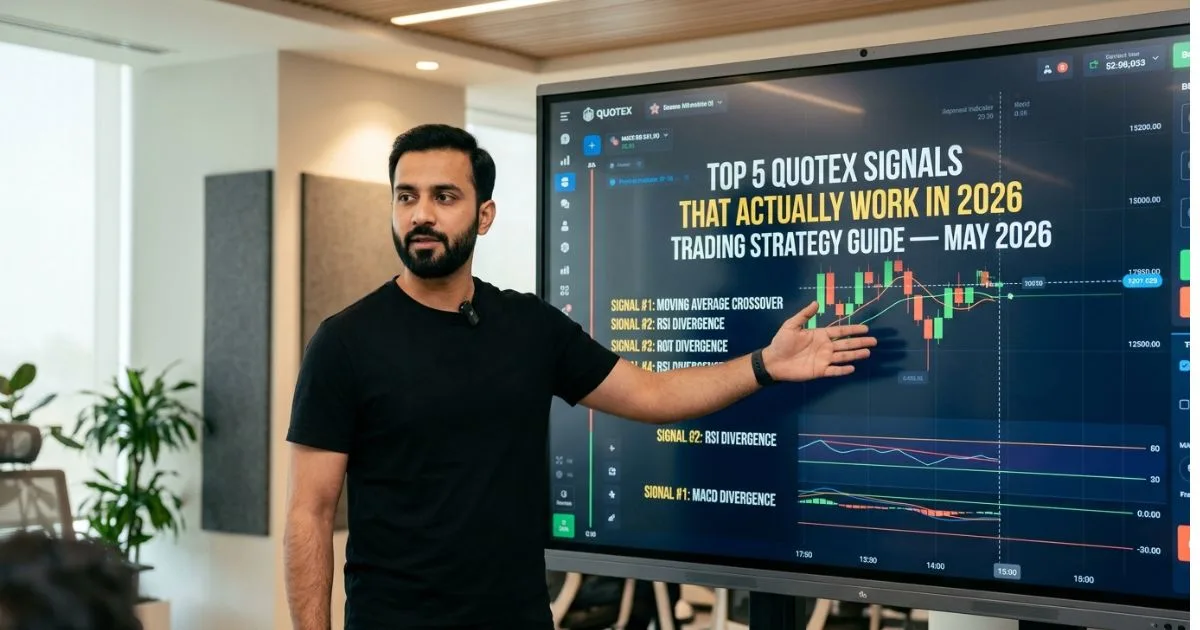
Top 5 Quotex Signals That Actually Work in 2026 | OTC vs Live Market Strategy Guide
Trading Strategy Guide — May 2026
Top 5 Quotex Signals That Actually Work in 2026
📅 May 16, 2026⏱ 12 min read📈 Intermediate Level🌍 OTC + Live Market
Not every signal works. Most of what you see on YouTube or Telegram groups is outdated, cherry-picked, or flat-out wrong. This guide breaks down five real signals — tested on both OTC and live markets — that experienced Quotex traders are actually using to make consistent profits in 2026.
Let me be honest with you from the start. There is no signal that wins 100% of the time. Anyone promising you that is selling you a dream. What does exist are setups that have a statistical edge — and if you apply them consistently with proper risk management, you come out profitable over time.
The signals in this article are built around real candlestick analysis, actual market structure, and an understanding of how Quotex operates — including the critical difference between OTC mode and live market trading that most beginner traders completely ignore.
First Things First: OTC Market vs Live Market on Quotex
Before you trade a single dollar on Quotex — before you look at a single signal — you must understand this: are you looking at an OTC chart or a live market chart? Because everything changes depending on your answer.
Most traders open Quotex, pick any currency pair, and start clicking UP or DOWN. But they do not realize that on a Saturday afternoon, the EUR/USD they are trading is not the real EUR/USD. It is a simulated OTC price generated by the broker. The behavior of this chart is fundamentally different from the real market.
⚡ OTC Market
→Available 24/7 including weekends
→Price is broker-simulated, not real data
→Tends to range and consolidate more
→Less influenced by economic news
→Best for: range-bound strategies
→Avoid: strong trend-following signals
🌍 Live Market
→Active only during market hours
→Real-time prices from global exchanges
→Stronger, more sustained trends
→Reacts to economic news & events
→Best for: trend following, MA crossovers
→Avoid: trading during news releases
⚠ Critical Rule
When you open Quotex, check your asset name. If it shows "EUR/USD (OTC)" — you are on the simulated market. If it shows "EUR/USD" — you are on the live market. Your strategy must match the market type. Using a live-market trend strategy on OTC will burn your account.
How to Read Candlestick Charts on Quotex
Every signal in this article is built on candlestick analysis. Each candle tells you four things: the open, the close, the high, and the low of that time period. Green candles mean buyers were in control. Red candles mean sellers won. The thin wicks show how far price stretched before reversing.
The 3 Candle Patterns Every Quotex Trader Must Know
1. The Doji — Open and close are nearly the same, forming a cross shape. Market is undecided. A doji after a strong trend is a major reversal warning. Watch for what comes next.
2. The Pin Bar (Hammer / Shooting Star) — Tiny body, very long wick on one side. A pin bar with a long lower wick at support = CALL signal. Buyers rejected the lower price hard. A pin bar with a long upper wick at resistance = PUT signal. Sellers slammed the door on the rally.
3. The Engulfing Candle — A large candle that completely swallows the previous candle's body. Green engulfing after red candles = CALL. Red engulfing after green candles = PUT. The bigger the engulfing, the stronger the signal.
1
✅ Works on OTC + Live Market
Signal #1: Support & Resistance Bounce
Estimated win rate (with confirmation)
68–74%
This is the foundation of almost every profitable Quotex trader's strategy. Support and resistance are price zones where the market has previously reversed. The more times price has tested a level without breaking through, the stronger that level becomes — and the more reliable it is as a signal.
Think of support as the floor and resistance as the ceiling. When price falls to the floor and bounces — that is your CALL. When price rises to the ceiling and turns back down — that is your PUT.
Strong Resistance (3+ touches)→ PUT trade at touch
Weak Resistance (1–2 touches)→ Wait for confirmation
Strong Support (3+ touches)→ CALL trade at touch
Broken Support (now resistance)→ PUT on retest
How to Apply This on Quotex — Step by Step
1
Set your chart to 5-minute timeframe
Open any asset on Quotex. Set candles to 5 minutes. Look back at the last 50–100 candles to identify your zones.
2
Draw horizontal lines at obvious price levels
Find zones where price reversed at least twice. These are your levels. Draw a horizontal line at each one and wait.
3
Wait for price to reach the level
Do not predict — wait. When price approaches your line, zoom into the 1-minute chart and watch for a reversal candle.
4
Enter only on the confirmation candle
A pin bar, doji, or engulfing at the level is your confirmation. Without it, skip the trade. No confirmation = no entry.
5
Set expiry to 1–5 minutes
On a 5-minute chart use 5-minute expiry. On a 1-minute chart use 1-minute expiry. Longer expiries dilute the signal.
💡 Pro Tip
On OTC markets, support and resistance is even more reliable because price tends to range. This makes it the single best strategy for weekend OTC trading on Quotex.
2
⚡ Best for Live Market
Signal #2: RSI Divergence Setup
Estimated win rate (confirmed divergence)
65–72%
RSI is one of the most misused indicators in trading. Most beginners look at whether RSI is above or below 70/30 and trade on that alone. That is not a strategy — it is gambling. The correct way to use RSI on Quotex is to look for divergence — where RSI and price tell different stories.
What is RSI Divergence?
Divergence happens when price makes a new high but RSI fails to confirm it. This tells you the momentum behind the move is weakening — buyers are running out of energy. A reversal is coming. There are two types you need to know:
Bearish DivergencePrice: higher high / RSI: lower high → PUT
Use RSI with period 14 (default). Set overbought at 70, oversold at 30. Apply it on the 1-minute or 5-minute chart. The best divergence setups happen exactly at a key support or resistance level — when both signals line up, your win probability jumps significantly.
⚠ Important
RSI divergence works best on the live market during trending conditions. On OTC markets, divergence signals are less clean because the simulated price does not follow natural market momentum as reliably.
3
⚡ Excellent for OTC Market
Signal #3: Bollinger Band Squeeze & Breakout
Estimated win rate (confirmed breakout)
62–70%
Bollinger Bands have three lines: a middle line (20-period MA) and upper/lower bands two standard deviations away. When the bands squeeze together, price is coiling up energy — a big move is coming. Your job is to identify the squeeze and catch the breakout.
The Squeeze Strategy — Step by Step
1
Add Bollinger Bands (20, 2) to your chart
Go to indicators on Quotex, add Bollinger Bands with period 20 and standard deviation 2. This is the default setup.
2
Wait for the bands to compress tight
Watch until upper and lower bands come very close together with small sideways candles. This is your waiting phase — the spring is compressing.
3
Enter on the candle that closes outside the band
Candle closes above upper band → CALL. Candle closes below lower band → PUT. Wait for the full close. Never enter mid-candle.
4
Use 3–5 minute expiry after the breakout candle
Breakouts continue for 2–5 candles. On 1-minute chart use 3-minute expiry. On 5-minute chart use 5–10 minute expiry.
💡 OTC Special Tip
On OTC markets, Bollinger squeezes happen very frequently because price ranges and consolidates. This makes it one of the most productive strategies for weekend OTC trading. Practice identifying squeezes on demo first.
4
✅ Works on OTC + Live Market
Signal #4: Pin Bar Reversal (Pure Price Action)
Estimated win rate (at key level)
66–75%
The pin bar is the single most powerful candlestick signal on Quotex — and you need zero indicators to use it. It is pure price action. When a pin bar forms at a key level, the market is giving you a direct message: smart money has entered and is pushing price the other way.
What Makes a Valid Pin Bar?
Rule 1: Wick LengthWick must be 2–3× the body length
Rule 2: LocationMust form at support or resistance
Rule 3: ContextMust come after a directional move
A bullish pin bar (hammer) at support — long lower wick, buyers rejected lower price hard — enter CALL on the next candle open.
A bearish pin bar (shooting star) at resistance — long upper wick, sellers slammed the rally down — enter PUT on the next candle open.
🚫 Avoid This Mistake
Never trade a pin bar that forms in the middle of nowhere — no level, no context, just a random spike. These are market noise. Every valid pin bar must form at a previously identified zone. No zone = no trade.
5
⚡ Best for Live Market — Trending Assets
Signal #5: Moving Average Crossover (EMA 5/20)
Estimated win rate (trending market only)
60–68%
EMA crossovers are widely taught but mostly applied wrong. On Quotex, the EMA 5/20 crossover on trending live market assets during active sessions produces reliable, repeatable entries. The key word is trending — this strategy fails completely in ranging, choppy markets.
Always use EMA (Exponential Moving Average), not SMA. EMA reacts faster to new price data — critical on a fast-moving Quotex chart. SMA is too slow and will have you entering after the move already happened.
EMA 5 crosses above EMA 20→ CALL (uptrend signal)
EMA 5 crosses below EMA 20→ PUT (downtrend signal)
Add RSI confirmation for stronger entries: EMA crossover up + RSI above 50 = strong CALL. EMA crossover down + RSI below 50 = strong PUT. Double confirmation reduces false signals by roughly 20%.
💡 Best Assets for EMA Crossover
During London and New York sessions: EUR/USD, GBP/USD, USD/JPY trend most clearly. Avoid crypto assets (too volatile) and all OTC assets for this signal. Live market, trending pairs only.
Risk Management: The Part That Determines Whether You Survive
You can know all five signals perfectly and still blow your account without proper risk management. This is not an exaggeration — it is simple mathematics. Here are the non-negotiable rules every serious Quotex trader follows:
→
Never risk more than 2–3% of your account per trade
If your balance is $200, max trade size is $4–$6. Sounds small — it is the only thing keeping you in the game long enough to make money.
→
Set a daily loss limit
If you lose 10–15% of your balance today, stop trading for the day. No exceptions. Most account blowups come from one bad session of revenge trading.
→
Maximum 3–5 trades per session
More trades means more impulsive, signal-less entries. Profitable traders are selective. Quality over quantity, always.
→
Never trade during major news releases
NFP, Fed rate decisions, CPI — these cause unpredictable price spikes. No signal works during these moments. Check an economic calendar before every session.
🚫 Risk Warning
Trading binary options on Quotex involves significant risk of loss. Over 75% of traders lose money. The strategies in this article are educational and do not guarantee profit. Always practice on demo first and never trade with money you cannot afford to lose.
The Bottom Line
Five signals. Hundreds of possible setups. But traders who consistently profit on Quotex are not the ones who know the most signals — they are the ones who master one or two deeply and apply them with iron discipline.
Start with Signal #1 — Support & Resistance. It works on both OTC and live market. Once your win rate is above 65% on demo for two weeks straight, layer in one more signal. Build from there. Trading is a skill. It takes time. But with the right framework, you have a real foundation to build a profitable practice in 2026.
Frequently Asked Questions
What is the best signal for Quotex in 2026? +
The most reliable combination in 2026 is Support & Resistance + RSI divergence on the 5-minute chart. When price reaches a tested support level and RSI shows oversold divergence, a CALL trade has a high win rate — especially during London and New York live market sessions. For OTC-only traders, the Bollinger Band squeeze combined with support/resistance is the most consistent setup.
What is the difference between OTC and live market on Quotex? +
The live market reflects real-time global prices from forex and crypto exchanges — active only during trading hours. OTC is available 24/7 including weekends, with broker-simulated prices. Strategies must match the market type. OTC needs range-based setups; live markets support trend-following. Always check if your asset shows "(OTC)" in the name before choosing a strategy.
Do Quotex signals actually work? +
Yes — but only with proper risk management and market context. Signals based on RSI, Bollinger Bands, and Support/Resistance work consistently when the trader understands OTC vs live market, uses the correct timeframe, and does not overtrade. No signal wins 100%. The goal is finding setups that win above 65% over a large sample and managing losing trades so they do not wipe out gains.
What timeframe is best for Quotex signals? +
The 5-minute chart with 5-minute expiry is best for beginners — clearer signals and more forgiving timing. The 1-minute chart is for experienced traders who can read price action quickly. Confirm signals on the 5-minute chart and use the 1-minute chart to time your exact entry. Never use the tick chart — it is too noisy and random.
Can I use these signals on a Quotex demo account? +
Absolutely. Quotex gives you a free $10,000 demo account you can reload anytime. Practice every strategy on demo for at least 2–3 weeks. Log every trade — date, asset, market type, signal used, result. Aim for 65%+ win rate consistently before considering real money. The demo uses real market data during trading hours so your results will be close to live conditions.
How many signals should I use at once? +
Start with one. Master it completely before adding another. Most profitable traders use maximum two or three signals they deeply understand — not ten they half-understand. Pick Support/Resistance and one confirming indicator like RSI or Bollinger Bands and build your entire strategy around that combination for the first few months.
What is the best asset to trade on Quotex for beginners? +
For live market: EUR/USD and GBP/USD. Highest liquidity, clearest chart patterns, most predictable behavior during London and New York sessions. For OTC: EUR/USD (OTC) is most popular and shows cleaner support/resistance levels than exotic OTC pairs. Avoid crypto until you have solid experience — significantly more volatile with more false signals.
Risk Disclaimer: Trading binary options involves substantial risk of loss and is not suitable for all investors. Strategies described here are for educational purposes only and do not constitute financial advice. Past performance is not indicative of future results. More than 75% of retail accounts lose money trading binary options. Only invest what you can afford to lose completely.